◉ Transport Safety & Logistics (15%)◷ 100–130 minutes▥ Intermediate▣ Reviewed July 2026
Learning objectives
After completing this chapter, you should be able to:
Explain why communication is a clinical intervention during maternal-fetal transport rather than an administrative task.
Gather and transmit the maternal, fetal, neonatal, operational, and legal information required before departure.
Use structured tools such as SBAR, handoff frameworks, call-outs, check-backs, and closed-loop communication.
Lead a concise predeparture team brief that defines roles, priorities, anticipated complications, and escalation triggers.
Communicate medication, infusion, device, fetal-monitoring, laboratory, and treatment information without dangerous ambiguity.
Provide timely en-route updates when maternal condition, fetal status, treatment, destination, or estimated arrival time changes.
Perform an interactive bedside handoff that transfers information, authority, and responsibility to the receiving team.
Document transfer acceptance, communications, changes, therapies, records, and final disposition clearly.
Recognize communication barriers and use advocacy, assertion, and escalation when safety concerns are not acknowledged.
Opening transport scenario
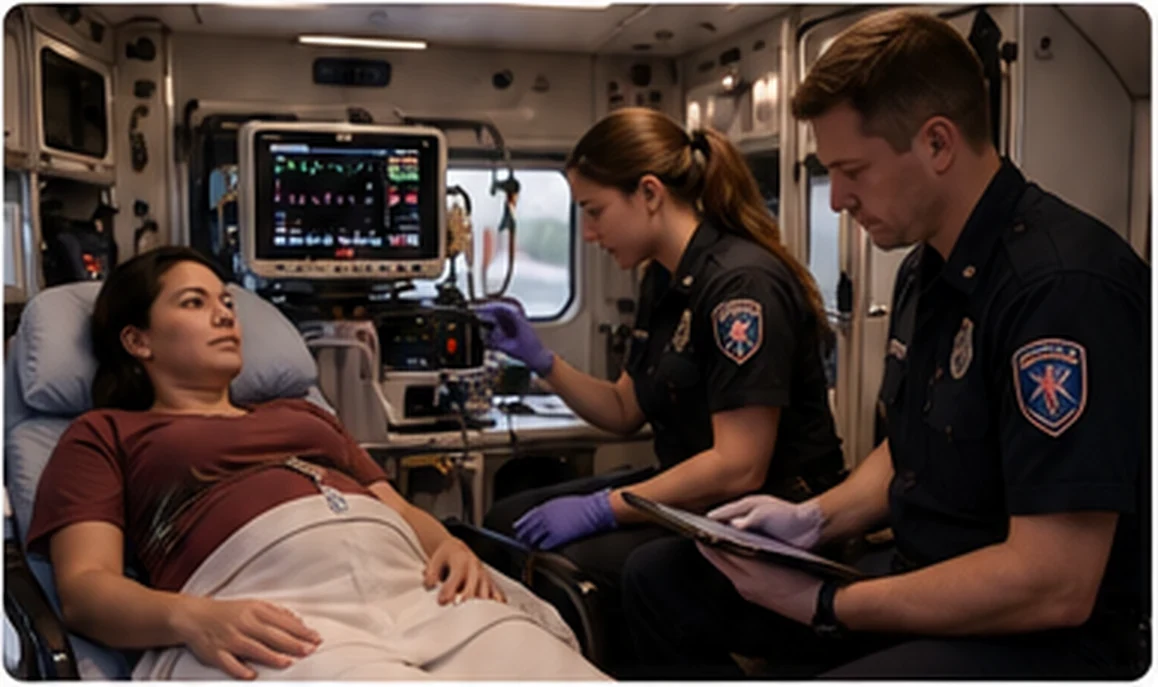
The handoff is a clinical safety event. The receiving team must understand the patient’s current maternal and fetal status, therapies, trajectory, unresolved risks, and immediate plan. AI-generated clinical training image.
Two patients, multiple teams
A maternal transfer can fail even when every individual clinician is technically competent.
A 31-year-old patient at 30 weeks’ gestation is accepted for transfer because of severe preeclampsia. The referring physician speaks with the receiving maternal-fetal medicine specialist. The bedside nurse gives report to the transport clinician. The fetal strip is sent electronically, but the latest tracing is not included. The magnesium infusion is described as “running at two,” without a unit, concentration, or pump-channel confirmation. The transport team is told the neonatal intensive care unit knows about the patient, but no neonatal bed status is confirmed.
During loading, the patient develops a severe headache and fetal heart-rate decelerations. Each team possesses part of the story, but no one has the complete operational picture.
1. Communication is a clinical intervention
Communication determines what the next clinician knows, anticipates, prepares, and does. In maternal-fetal transport, information must cross professional, organizational, and geographic boundaries while the condition of the mother and fetus may change rapidly. A complete handoff is therefore part of stabilization, not something that occurs after stabilization.
A
Accurate
Use verified findings, exact medication information, time-stamped trends, and standardized fetal terminology. Separate facts from impressions.
T
Timely
Communicate early enough for the receiving team to mobilize resources, and update whenever the clinical or operational picture changes.
R
Relevant
Prioritize information that affects risk, treatment, destination, preparation, and immediate decisions. Avoid burying critical facts in chronology.
I
Interactive
Allow questions, clarification, repeat-back, and correction. A one-way recital is not a completed handoff.
C
Confirmed
Verify that the intended receiver heard and understood the message and has accepted the associated responsibility.
2. Pretransport communication
Maternal transport begins with several linked conversations: referral and consultation, receiving-facility acceptance, bedside report, transport-team briefing, patient discussion, and operational coordination. The transport team should identify missing information before movement makes clarification difficult.
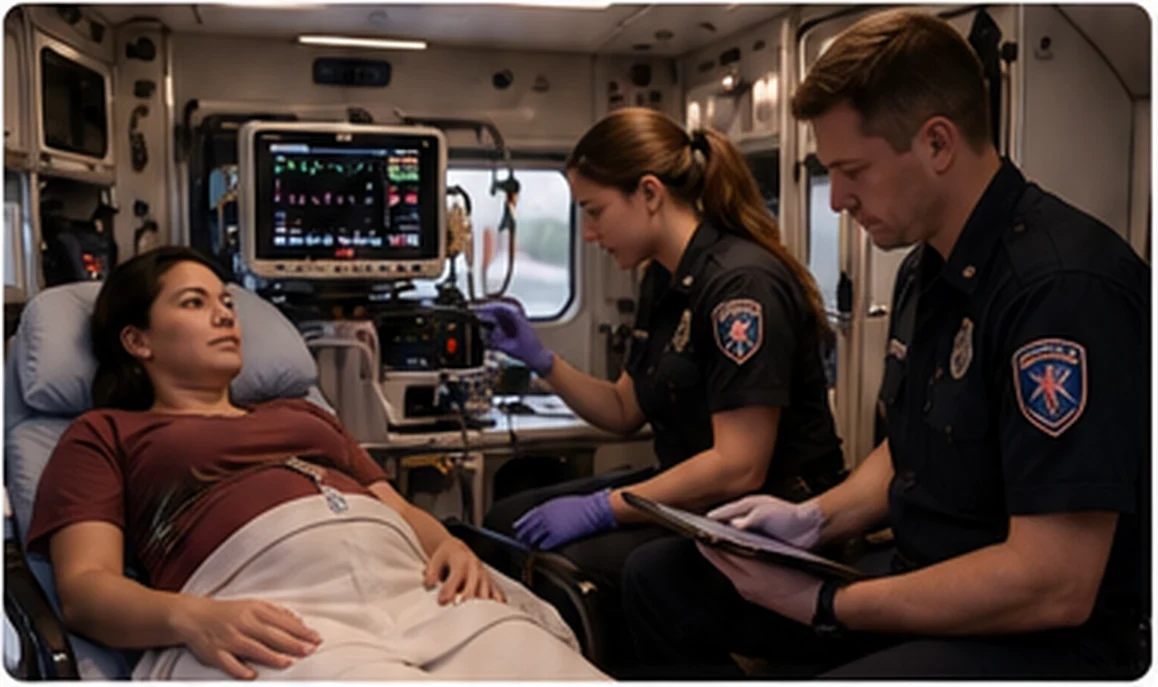
Clarify before departure. The transport clinician should know why the patient is moving, who accepted the transfer, what has changed, what is running, and what may happen next. AI-generated clinical training image.
Minimum predeparture picture
Patient identifiers, gestational age, gravida/para history, allergies, weight, and code or resuscitation status when applicable.
Reason for transfer, urgency, accepting clinician, receiving units, bed status, and destination capabilities.
Maternal diagnosis, vital-sign and neurologic trends, respiratory status, bleeding, contractions, membranes, pain, and urine output.
Fetal baseline, variability, accelerations, decelerations, tracing category when available, presentation, movement, and recent changes.
Laboratory and imaging results, blood type, Rh status, group B streptococcus status, and pending studies.
Medications, exact concentrations, doses, rates, last administrations, response, adverse effects, and rescue medications.
IV access, blood products, drains, catheters, airway or ventilator settings, fetal-monitoring equipment, and special devices.
Anticipated deterioration, prohibited or limited interventions, medical-control plan, diversion triggers, and delivery readiness.
2.1 Confirm acceptance and capability
The receiving hospital should have agreed to accept the patient and should possess the personnel and resources required for the anticipated maternal and neonatal needs. Document the accepting clinician, date and time, destination unit, and any contingency if the original unit or service becomes unavailable. “The transfer center is working on it” is not the same as confirmed acceptance.
2.2 Build a two-patient report
Maternal report
Diagnosis, severity, trajectory, and response to treatment
Gestational age, viability context, plurality, presentation, and known anomalies
Fetal heart-rate baseline, variability, accelerations, decelerations, and trend
Contraction pattern and relation to fetal changes
Antenatal corticosteroids, magnesium for neuroprotection, and other fetal-directed therapy
Expected neonatal needs, neonatal team notification, and neonatal intensive care capability
3. Structured communication tools
A structured tool does not replace clinical judgment. It reduces omissions and creates a predictable order so the receiver can recognize what is missing. Different tools fit different moments.
3.1 SBAR for requests and focused updates
S
Situation
Who is the patient, where are you, and what is happening now?
“We are 22 minutes from the destination with a 30-week patient whose blood pressure and fetal tracing have worsened.”B
Background
What essential context explains the current problem?
What do you believe is occurring, and what findings support it?
New pulmonary edema with recurrent late decelerations and increasing maternal oxygen requirement.R
Recommendation
What do you need the receiver to do or decide?
Activate obstetric, anesthesia, neonatal, and respiratory resources; advise regarding diversion and immediate treatment.
3.2 Closed-loop communication for critical actions
1Send
State the person’s name, action, dose or task, and urgency.
→
2Check back
The receiver repeats the message in their own voice.
→
3Confirm
The sender verifies or corrects the readback and acknowledges completion.
Critical details require a check-back. Medication concentration, infusion rate, pump channel, oxygen setting, fetal change, and destination decision should never rely on an ambiguous acknowledgment. AI-generated clinical training image.
Unsafe versus closed loop
Unsafe: “Increase the magnesium.” — “Okay.”
Closed loop: “Jordan, continue magnesium sulfate at 2 grams per hour from the 20-gram-in-500-mL bag on pump channel B.” — “Magnesium 2 grams per hour, 20 grams in 500 mL, channel B.” — “Correct. Tell me when the setting is verified.”
Closed-loop communication is especially important when noise, movement, masks, radios, fatigue, unfamiliar concentrations, or multiple teams increase the chance of misunderstanding.
3.3 Call-outs and shared mental models
A call-out gives the entire team essential information at the same time: “Fetal heart rate is 90 and has remained below 100 for three minutes.” A shared mental model means team members understand the same patient priorities, likely next events, roles, destination, and contingency plan.
4. Team brief and role clarity
A brief aligns the mission. The team should leave the sending facility knowing the patient priorities, individual roles, expected complications, destination, route, and triggers for changing the plan. AI-generated clinical training image.
Two-minute transport brief
Patient: diagnosis, maternal and fetal stability, labor status, and most important trend.
Mission: destination, acceptance, route, estimated time, and alternate facilities.
Roles: team leader, maternal assessment, fetal monitoring, airway, medications, documentation, and vehicle operation.
Role assignment does not prevent team members from cross-checking each other. It prevents diffusion of responsibility. The phrase “someone should call” is weaker than “Alex, call the receiving labor unit now and confirm that obstetric anesthesia and the neonatal team are activated.”
5. Communication with the patient and support person
The patient is a member of the care team and may identify omissions, allergies, prior complications, medication discrepancies, or changes in fetal movement. Explain the purpose of transfer, what the team will monitor, expected travel time, positioning, restrictions, potential diversion, and what to report immediately.
Use plain language
Replace unexplained abbreviations and jargon with clear statements. Confirm understanding rather than asking only, “Do you understand?”
Use qualified language services
Use an interpreter or approved communication aid when language or hearing barriers could affect consent, assessment, or safety.
Preserve dignity and autonomy
Provide privacy, explain exposure and procedures, obtain permission when possible, and avoid speaking about the patient as though she is absent.
Invite symptom reporting
Ask the patient to immediately report headache, visual change, dyspnea, bleeding, urge to push, chest pain, fluid loss, or decreased fetal movement.
6. En-route communication
Good communication is continuous. The initial report becomes outdated as soon as the patient changes. Establish who receives routine updates, how urgent updates are transmitted, and what information must trigger immediate contact.
Update triggers
New or worsening maternal hypoxemia, hypotension, severe hypertension, altered mental status, seizure, chest pain, hemorrhage, or labor progression
New fetal bradycardia, recurrent decelerations, loss of reliable tracing with clinical concern, or major change in fetal status
Route delay, weather change, equipment failure, communication failure, revised estimated arrival time, or destination capability problem
Decision to divert, stop, prepare for delivery, or request additional resources
Update from the current picture, not the departure picture. Use time-stamped maternal and fetal trends, interventions, response, remaining travel time, and the action requested. AI-generated clinical training image.
6.1 A focused transport update
Identification and location: unit, patient, gestational age, current location, and remaining time.
Change: exact maternal or fetal finding and time it began.
Current status: vital signs, fetal pattern, contractions, bleeding, oxygenation, mental status, and relevant examination.
Actions and response: treatment, medication, dose, time, and clinical response.
Need: advice, activation, diversion decision, resources, or preparation requested.
7. Handoff to the receiving team
A handoff transfers information together with authority and responsibility. It should occur with the correct receiving clinicians present, at a moment when they can listen, examine the patient, ask questions, and confirm the plan. Continue necessary monitoring and therapy until the receiving team explicitly assumes responsibility.
1PrepareOrganize the story, trends, records, pumps, and unresolved issues.
→
2PresentGive a concise, structured maternal-fetal summary.
→
3VerifyUse questions and repeat-back for critical information.
→
4TransferTrace lines, reconcile medications, move equipment, and define the immediate plan.
→
5CloseConfirm responsibility, document names and times, and address remaining questions.
7.1 Bedside handoff sequence
Opening sentence
Identify the patient, gestational age, primary diagnosis, reason for transfer, and current level of concern.
Maternal trajectory
Explain how the patient changed from referral through transport, not just the last vital signs.
Fetal trajectory
Give baseline, variability, accelerations, decelerations, contractions, tracing quality, and response to interventions.
Therapies and devices
State exact medications, concentration, dose, rate, last bolus, access, oxygen, airway settings, blood, catheters, and devices.
Immediate risks
Name what could happen next and which finding would trigger seizure treatment, hemorrhage response, airway support, or urgent delivery.
Pending and unresolved
Identify pending labs, missing records, incomplete consultation, family issues, unavailable blood, or any uncertainty.
7.2 Medication and line handoff
Do not rely on the medication label alone. Trace each line from patient to source, name the medication, concentration, dose, rate, pump channel, remaining volume, last change, and clinical target. Confirm which team owns the pump during equipment transfer. A medication should never be briefly unowned while both teams assume the other is monitoring it.
8. Documentation, records, and privacy
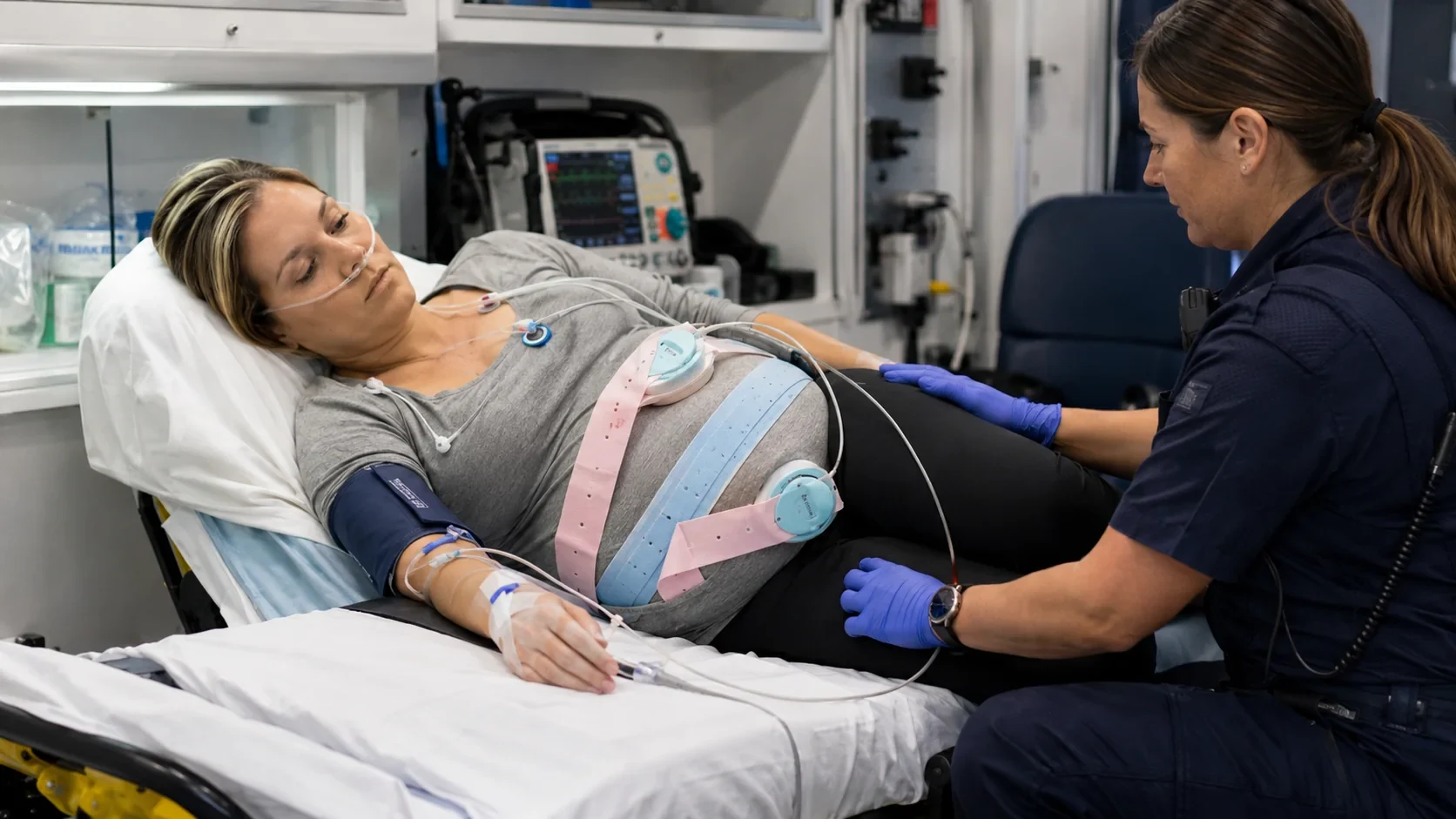
Records must travel with the patient’s story. Electronic transmission does not eliminate the need to confirm that the receiver can access the latest results, tracing, medication record, and transfer documents. AI-generated clinical training image.
Document the communication itself
Date and time of referral, consultation, acceptance, departure, significant updates, diversion, arrival, and handoff
Names and roles of accepting, sending, medical-control, receiving, and transport personnel
Maternal and fetal condition at transfer, interventions provided, response, and unresolved concerns
Records sent: history, diagnostic results, fetal strips, medication administration record, consent or certification, and transfer documents
Changes communicated during transport and instructions received
Final bedside handoff, medication and device transfer, questions addressed, and responsibility accepted
Use approved secure systems for protected health information. Avoid transmitting identifiable patient information through personal text, unencrypted email, social media, or consumer messaging platforms unless the organization has explicitly approved and secured the system. When electronic systems fail, use the organization’s downtime process and ensure essential paper or verbal information reaches the receiver.
9. Barriers, escalation, and speaking up
Noise and interruption
Pause nonessential conversation, move closer, use headsets, repeat critical information, and restart a handoff if attention is lost.
Assumptions and familiarity
Do not assume another team knows local abbreviations, pump concentrations, fetal terminology, or the reason a treatment was chosen.
Hierarchy
Invite concerns, use names and direct language, and escalate when a safety issue is dismissed.
Workload and task fixation
Assign a communicator, protect the handoff from interruption, and use a checklist when clinical tasks compete for attention.
Language and health literacy
Use qualified interpreters and teach-back. Family members may support the patient but should not replace a qualified interpreter for critical communication.
Fragmented records
Identify what is missing, who is retrieving it, what decisions depend on it, and how the information will reach the receiving team.
9.1 Advocacy and escalation
CConcerned
“I am concerned that the fetal heart rate has remained below 90.”
UUncomfortable
“I am uncomfortable continuing another 35 minutes without reassessing the destination.”
SSafety issue
“This is a safety issue. We need medical control and a diversion decision now.”
2×Two-challenge rule
If the first concern is not acknowledged, state it again clearly and escalate through the chain of command.
Advocacy should be respectful and direct. The goal is not to win an argument; it is to make the risk visible and ensure that the person with authority recognizes and responds to it.
10. Evolving case study
Phase 1: Referral and acceptance
A 30-week patient with severe preeclampsia is accepted by a maternal-fetal medicine physician. The sending nurse reports that magnesium is “at two,” labetalol was “given earlier,” and the fetal tracing is “okay.” The transfer packet contains laboratory results from four hours ago.
Communication action: Clarify the magnesium concentration and dose in grams per hour, pump channel, loading dose, last labetalol dose and response, current reflexes and urine output, current maternal vital signs, current fetal baseline and variability, decelerations, tracing time, pending laboratory results, and who accepted the transfer. Obtain or transmit the latest fetal strip and medication administration record.
Phase 2: En-route change
Twenty-five minutes into transport, the patient develops dyspnea, SpO₂ falls to 92%, blood pressure is 174/112 mm Hg, and recurrent late decelerations appear. The receiving facility is 32 minutes away; a capable alternate is 9 minutes away.
Communication action: Give an immediate call-out to the team, perform closed-loop task assignment, contact medical control and receiving systems with an SBAR update, communicate treatment and response, state the time-sensitive maternal and fetal concerns first, and request a destination decision. Document the names, time, recommendations, and revised plan.
Phase 3: Arrival and transfer of responsibility
The team diverts. On arrival, several clinicians begin moving the patient while another clinician asks for report. The magnesium pump remains attached to the transport stretcher, and the receiving pump is not yet ready.
Communication action: Protect the handoff from interruption, maintain monitoring and therapy, identify who is receiving responsibility, provide the concise maternal-fetal trajectory, trace the IV line and confirm the infusion concentration and rate, transfer the pump only through an explicit plan, identify immediate risks and pending information, answer questions, and document that the receiving team assumed care.
11. High-yield chapter summary
Communication is a clinical intervention that influences preparation, treatment, destination, and outcomes.
A maternal transport handoff must communicate the status and trajectory of both mother and fetus.
Confirm the accepting clinician, receiving capability, destination unit, and contingency plan before departure.
Use exact medication concentration, dose, rate, units, pump channel, last administration, response, and rescue plan.
SBAR is useful for focused requests and changing conditions; handoff tools support transfer of the larger story.
Closed-loop communication requires a message, receiver readback, and sender confirmation.
A predeparture brief creates shared priorities, roles, threats, triggers, and contingency plans.
Include the patient, use plain language, and use qualified language services when needed.
Update the receiving system whenever maternal condition, fetal status, therapy, ETA, route, equipment, or destination changes.
A handoff transfers authority and responsibility, not information alone.
Continue monitoring and therapy until the receiving team explicitly assumes care.
Trace lines and reconcile medications and devices during equipment transfer.
Document acceptance, communications, records sent, changes, instructions, handoff, and final transfer of responsibility.
Use advocacy, assertion, and escalation when a safety concern is not acknowledged.
Embedded knowledge checks
What makes a handoff different from simply giving a report?
Answer: A handoff is interactive and transfers information together with authority and responsibility. The receiver must have an opportunity to ask questions, clarify critical details, and confirm the immediate plan.
What is missing when a nurse says magnesium is “running at two”?
Answer: The statement lacks units, concentration, dose basis, pump channel, route, and verification. A safe report would state the bag concentration and the dose in grams per hour, then use readback.
When should the receiving team receive an en-route update?
Answer: Whenever maternal or fetal condition, treatment, route, destination, estimated arrival time, equipment status, or anticipated resource need changes meaningfully.
What should happen if a safety concern is dismissed?
Answer: State the concern again with clear risk language, use the organization’s advocacy tool or two-challenge rule, and escalate through the chain of command or medical control.
References
International Board of Specialty Certification. Maternal Fetal Transport Microcredential Candidate Handbook. Updated April 2026.
Society for Maternal-Fetal Medicine Patient Safety and Quality Committee. A Maternal Transport Briefing Form and Checklist. Reaffirmed 2025. https://publications.smfm.org/publications/335-society-for-maternal-fetal-medicine-special-statement-a/
Agency for Healthcare Research and Quality. TeamSTEPPS Communication Module: Overview of Key Concepts and Tools. https://www.ahrq.gov/teamstepps-program/curriculum/communication/overview/
Agency for Healthcare Research and Quality. Closed-Loop Communication and Check-Back. https://www.ahrq.gov/teamstepps-program/curriculum/communication/tools/loop.html
Agency for Healthcare Research and Quality. Handoff. https://www.ahrq.gov/teamstepps-program/curriculum/communication/tools/handoff.html
American College of Obstetricians and Gynecologists. Communication Strategies for Patient Handoffs. Committee Opinion.
Centers for Medicare & Medicaid Services. Emergency Medical Treatment and Labor Act and Appendix V interpretive guidance for appropriate transfer, acceptance, and medical records. https://www.cms.gov/medicare/regulations-guidance/legislation/emergency-medical-treatment-labor-act
American College of Obstetricians and Gynecologists. Transfer Protocols for Out-of-Hospital Birth. 2025.